There has already been a post about Grandpa Rex Norman's military service (In the Army Now) which showcases some family furlough photos and portions of his written history. As we continue to research, additional photos and documents have been uncovered. So here's a few more peeks into Grandpa Rex's military service. Two new photos (above) and some paperwork (below, click on any image to enlarge).
This record shows the duties/positions, work experience and prior education
as well as dates entering and leaving the service.
We found it interesting to note on the discharge papers, that Grandpa Rex was only 5'7" and 151 pounds. This also includes "Decorations and Citations" and we are grateful he didn't need to go into action overseas!
Certificate of Appreciation
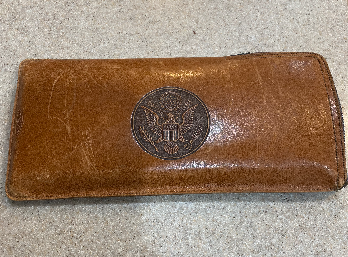
This was the pouch that Grandpa kept these papers in.
Rex and Zada got married in April 1938. They lived in Fairview for the first year. Their first apartment was one large room. A small bedroom and a little pantry. Grandma writes in her history that she used to hide behind the kitchen stove to bathe in a round tub. Nelva was born there March 20, 1939.
Grandpa Rex wrote in his history ~ On July 13, 1938, I went to work for the State Road Commission and a highway survey crew. We were now able to rent us a house of our own in Fairview, for the amount of $5.00 a month. We did have to buy a kitchen range (coal) with a hot water reservoir attached. We lived there until the spring of 1939, at which time our first daughter, Nelva Loy was born. This was on March 20th, and eleven days later we moved to Mt. Pleasant, Utah. We now had to pay $15.00 for our apartment.
Then Rex got a job with Young & Smith Construction Company and they moved out to Thompson, Utah (near Green River). There wasn't adequate housing, so Rex and his father built a little trailer (pictured above) which became home and it was nice to have it on wheels ... as it traveled!
Rex wrote ~ The job was out in the middle of the desert at a railroad junction. There was no housing available there so Dad decided to build me a trailer house. As I had no money to buy material, I made arrangements with a lumber company for the materials and in return gave the trailer house as security for the loan. I went out to the job alone for the first week and lived, ate, slept and did my book work in the car. I came home after about 10 days and Dad had built the trailer except for some painting and the clearance lights. We worked late into the nights getting it ready and able to leave on Monday morning with all our possessions inside.
After Thompson, they went to Emery. From Emery, they went to Rockville, which is at the entrance to Zions Park. They had lots of company and sometimes would have to eat in shifts in the little trailer.
From Rockville, they moved to Ogden and parked the trailer at Aunt Leolas. Then they moved into a (Zada's history says motel, Rex's says cabin) for a bit while the trailer house was used out at a job by Rex's Dad. The construction company didn't have any work after that, so Rex and Zada went back to Mt. Pleasant and parked the trailer at Rex's parent's house.
When spring came, Rex had a job with Morrison & Merrill, paid $100 a month. They rented an apartment at 140 Girard Ave in Salt Lake City. Melvin and Berthell got a job nearby, and slept out back in the trailer house and Zada cooked for them.
The war was on, and Rex was drafted. Zada had two little girls now (Margie born November 7, 1942) and was pregnant again. Zada moved in with Rex's parents in Mount Pleasant. She ended up renting a house north of the Theater in Mt. Pleasant and Rex was able to come there a few times. That house was sold to become a car dealership, so they rented another house where Zada had a big garden.
The war ended, and Rex was coming home. The owners of the home they were renting needed it back, so there was a scramble for somewhere new. They looked to Salt Lake and found an immaculate white frame house with red shutters at 4568 Boxelder Street in Murray. They bought it.
They quickly replaced the old coal stove with natural gas. The school and church was about a mile away (a new church building was built later, which was much closer). There was a root cellar out back with a dirt floor and cement walls, it kept vegetables fresh all winter. There was a wooden play house above the cellar, where the kids would play.
After Nelva graduated, they bought a lot and Zada's brother Bert built their home at 2665 Spring Hollow Drive. They moved in October 1959. Zada had a decorator from Sears come help get things set up just right. This was the house that the Westra kids knew as "Grandma and Grandpa Norman's house".
Memories from Jen: I remember the steep side slope on the West. We'd run down it going so fast! There was a covered cement patio with cushy chairs where we'd spend many evenings with family. Grandpa had a barbeque grill tied-in directly to the gas line, I hadn't seen that before, all other BBQs needed a propane tank. There was a peach tree and raspberry bushes. There was an elementary school nearby that we'd go play at when we visited. I remember the laundry chute ... dropping things down it to someone waiting below. There were poles down the stairs, and we kids would run down the stairs and grab the bottom pole and swing around. All except one of the cousins (Emily?) whose arm would pop out of socket if she did it. Sometimes some kids would stand on one side, and some on the stairs on the other side, and we'd pretend we were in jail. The old sewing machine with the foot pedal was there in the hallway at the bottom of the stairs. The family room downstairs had some of Grandpa's deer heads/antlers hung on the wall. I remember Grandma's glass table in the living room ... I was always a little afraid someone was going to fall on it and break it! She had a lot of little breakable knick-knacks around too. I remember a little glass swan I loved to look at. Grandpa had collected rocks and polished them, and he had a nice arrowhead collection too.
Memories from Wendy: As a child, going to Grandma’s house always meant wonderful, delicious meals. I will never forget her wonderful home-made rolls! She filled a little blue bowl with home-made strawberry jam to spread on the piping hot rolls. Grandma had the most wonderful garden and we loved to pick raspberries at her house and fruit from her fruit trees. I’ll always remember how immaculate Grandma’s house was with everything in its place. I remember Christmas parties and family gatherings and playing with our cousins in Grandma's back yard. I remember rolling down the hill on the side of Grandma's house, blowing bubbles through spools, and bowling with milk jugs on her back porch.
... more memories? Send them to blackhambunch@gmail.com and I'll add them!
Hi Margie and LaMar, I hope you are doing well during all this craziness. You might find this interesting. Years ago I went to Grandma and Grandpa Norman's house and they let me scan a bunch of photos in their albums. I remember Grandpa telling me about a time when their family was quarantined because they had caught an illness. He remembered being stuck at home for a while and he and his brother weren't allowed outside of their yard. Here is the picture of them during this time. Notice the cross in their window. He said that let people know the family had been quarantined. I think it was most likely the Spanish Flu. It seems like the math works out on the years.
Mom's Response~ Thanks Nikki! Ive never seen the first picture and the explanation of the cross on the door! Yes, on the terrible Spanish Flu in 1918, when Rex would have been about 3 and Gordon 18 months younger. I remember when my Grandma Norman (Louella) told me that she and Herb were too sick to even care for the boys. And that it was the members of the Oddfellows and Rebekahs service organization that stepped in to help and care for them and their two little boys. Grandma said she doesn't know what they would have done without that help. So Grandma and Grandpa became members of the organization their whole life, as I remember, and held offices.
Taken from Herbert Lavar's Autobiography ... That fall, along in November (1918) I took the flu. There was a terrible amount of flu then. There were many, many people dying with it. They took me home from work. The doctor got there and told the fellow who took me home to get me to bed and take care of me. They fixed me up and asked me if we had any liquor in the house. Mother (Louella) said she didn't know what it was, but I had just purchased a case of something for Fred Rassmussen. He got me part of that, and he rubbed me with it. He then made a "hot toddy" for me. The Odd Fellow's Grand Noble got a nurse who stayed for three hours. Then he got another one, and she stayed for a couple of hours. That is the way it was for two or three days. At least they had someone there to take care of me night and day. I went unconscious, and the doctor asked Mother if we had any relatives around. She said the nearest was in Mt. Pleasant, Utah. He said she had better get them because I couldn't live. That was an awful thing to tell her. The girl that was at the depot came and got the two boys and took them down to her house to take care of them. They were homesick and lonesome so she brought them back the next morning, and they had the flu. Mother was still up and going. I was unconscious for thirteen days, and when I became conscious I had a hemorrhage. I bled the washbasin nearly full of blood. They got the doctor to our home, and he packed my head in snow (there was snow on the ground because it was just a little before Thanksgiving). He finally got it stopped. Mother asked what she should do if I had another one.He said to get him and get him fast. About an hour and a half later I had another one. They finally got a hold of him, and I was still bleeding when he got there. He finally got it stopped and shook his head. He told Mother she had better get the folks because I could not make it. She asked what she should do if I had another one. He said I couldn't survive another one. That made Mother feel awful bad. I could hear what they were saying, but I couldn't say anything. An hour or two later, I had a third hemorrhage. They got the doctor and he came in a hurry. When he came in and took care of me, he said to Mother, "Mrs. Norman, if he can make blood as fast as he has been making it lately, he will be well." He said I was in better shape than when he first came down. It had turned red instead of black. That was the last hemorrhage I had, but I laid there and couldn't do anything. I got to feeling better so was able to sit up in a chair. We still had the nurses there, and Mother came down with the flu. She was expecting another baby, and it was quite a turmoil. When I got so I could go out, I went to pay the nurses because I felt they were the first ones who should be paid. I asked each nurse how much we owed them, and each one replied , "Nothing". The Odd Fellow's Lodge had taken care of all the expenses including the coal we had to buy from the lumber yard. I always maintained if it hadn't been for the Lodge, I wouldn't be here today. I paid them back. I couldn't do it all at once, but I did it as fast as I could. I figured if they could do that much good for me, they could do that much good for someone else.
From Grandpa Rex Norman's History (this would have been a later quarantine)...
I was the oldest. I started school at the age of six. I can remember when my brother and sister both came down with Scarlet Fever. We were quarantined for over a month. The kids would bring my schoolwork home and place it on our fence for me. Dad had to live away from home during that period of time. I remember after about four weeks the doctor came and examined them and going over their bodies he found a couple of scales and kept us in for another week. We were sure mad and we called him Dr. Quack. We then had to fumigate the whole house. We had to stuff all the cracks and openings with rags and would do part of the house at a time.
(More from Mom) I remember when we were little kids on Boxelder St. and had measles and mumps, etc., how the county health dept. (?) came and put up a quarantine notice on your front door. I don't know when that practice was discontinued. We'll all have to do some research on those interesting times.
This age of technology provides us so many links and looks to the past. Cousin Nikki recently let us know about a discovery she had found. https://newspapers.lib.utah.edu/search ... this is a service that has scanned in old newspapers from all over Utah. From small city publications to the Salt Lake Tribune, old or new, you can search by date, by paper or even by keywords or names. Pretty cool!
When I (Jen) was young, once of my favorite fast food places was Skippers. I loved the fish and chips, but I also enjoyed reading the "paper" that the food was served on. Always interesting to get a peek of what is being presented in any time period. Here's just a peek at a paper from Mt. Pleasant ... perhaps Grandma Norman read this paper as she recovered from Nelva's birth a few days before.
(click here to get a closer look at this day 80 years ago!)
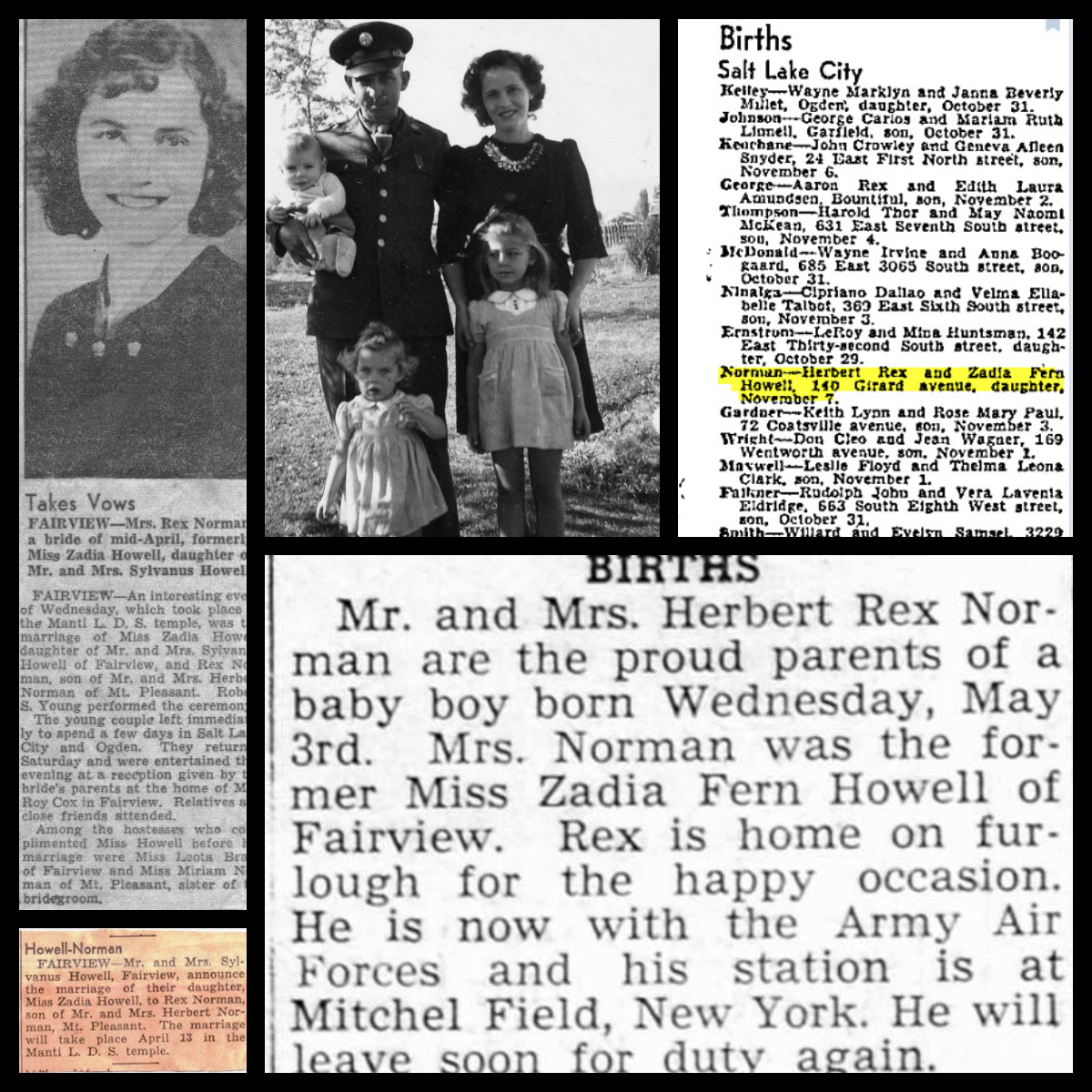
Grandma Zada and Grandpa Rex made some mentions themselves ... Marriages and Births
... and army activity
Looking back a little further - we can see Grandpa Rex's mom featured ...
I was born August 31, 1915 in Richfield, Utah to Herbert Lavar and Luella McGee Norman.
I was the first of five children in the family.
We moved a number of times during the first few years of my life. Dad was an agent for the railroad. Our first move was to Layton, Utah, then to Brigham City, Utah. My brother, Gordon, was born there March 10, 1917.
In June of 1918, Dad was given a job as a cashier clerk for the South Pacific Railroad at Elko, Nevada. My only remembrance was a schoolhouse burning down on Christmas day.
In February 1919, Dad was transferred to Lovelock, Nevada. My sister Miriam was born there on July 4, 1919. She was the first baby born in Pershing County, Nevada and her picture is in the corner stone of the courthouse.
We attended a Community Church with a Methodist minister, as there was no LDS Church. Missionaries came to town in 1921. I understand that there were only three LDS families there at the time. The missionary would stay at our place when they were in town. The folks didn’t charge them for staying. They would hold Sunday school at one of the other member’s homes as they had a piano.
I remember the Community Church burned down and the sparks landed on the roof of our home across the street. We moved within the city a few times and ended up across the street from the school. I remember they used to fly kites on the school grounds. I also recall taking dad’s hat that he used in working the bees and going next door to the vacant house that had lot of bees in it. We would swipe the honeycomb and eat it.
I started school at the age of six. During my second year on Christmas day they had a party and the Christmas tree was covered with candles and Santa’s beard caught on fire. I also recall on Christmas Eve just before we moved from Nevada. The folks had been visiting friends and on our returning home Santa Claus was just coming out of the door of our home. Gordon and I each received a good-sized car that we could pedal around in. There was a hayfield close by and I can recall that there was a flood and left dead fish laying all over it. I can remember when my brother and sister both came down the Scarlet Fever. We were quarantined for over a month. The kids would bring my schoolwork home and place it on our fence for me. Dad had to live away from home during this period of time.
I remember after about four weeks the doctor came and examined them and going over their bodies he found a couple of scales and kept us in for another week. We were sure mad and we called him Dr. Quack. We then had to fumigate the whole house. We had to stuff all the cracks and openings with rags and would do part of the house at a time.
In April of 1924 dad got tired of the railroad and moved back to Mt. Pleasant, Utah. He leased a farm and rented a home. Later they purchased the home that they now live in. That was in 1925 and it wasn’t much of anything but a shell but the folks finished it up real nice. There was no running water in the house and the bathroom (outhouse) was about 200 feet away at the lower end of the lot. On April 27, 1925 my second brother, Rowland, was born. Later on November 1, 1931 my second sister, Bonnie Lou, was born.
On weekends we would sometimes go to a place about fifteen miles away and visit friends. I remember one time they gave me a fishing pole and I went fishing. I asked why the cork on my line was going under the water all the time and they informed me that I had a fish on. That was my first experience at fishing. I can recall seeing hobos or tramps placing a sack over the end of pipes running under the railroad tracks and catching fish.
I recall that bout a month after I started my fourth grade of school, two other kids and myself were called into the principal’s office. We were all wondering what we had done wrong. We were told that we were promoted to the fifth grade. As I have looked back to that time, I have often wondered if it was a good thing. I was small for my age anyway and shy. Being with older student all my school life, I have never received any exposure to social life while in school. I can remember that Gordon and I were almost raised as twins and I was never able to do some things until he was old enough. Of course I didn’t like that.
We had three cows and a team of horses, called Ben and Nell, two large coops of chickens and I don’t recall how many pigs. We also raised sheep. Each spring I would help the sheep men during the lambing season, and every once in a while the mother ewe would not claim her lamb – these were called starves. They would give them to me and I would raise them on a bottle. Gordon and I were also raising rabbits. At one time we had over one hundred and we would kill, dress and sell them to other people besides eating a number ourselves. One night, dogs got into the pens and killed almost half of them. We set traps and caught one dog the next night.
We farmed and had a garden and raised pigs, chickens, etc. I can recall that we incubated eggs, both chickens and turkeys, for other farmers. We had over a thousand eggs being incubated at one time. Mother was handling this operation and we would help her turn each egg every day. They also had to be candled about three times during the incubation period, which was three weeks for chicken and four weeks for turkeys. During these times we would remove all the non-fertile eggs and any with dead cells.
We would also work in the hay fields for the other farmers at times for fifteen cents a day. I was bothered with hay fever so I had my problems. To help this condition we would cut the hay, rake it and pack it while it was still green. I always rode the horse on the derrick and to unload the hay into the barns. We also raised grain and peas. We would thin sugar beets for about 10 to 15 cents a row – they were long rows of hundreds of yards. One year, Gordon and I contracted to do an acre of beets, both blocking and thinning, for five dollars. It took us days and to this day I don't care if I never see another sugar beet.
As kids we would buy fish hooks for a penny each and with a piece of string would go fishing. We usually fished the Sanpitch River, which was about three or four miles from home. We would cut a willow as we went, to use as a pole. Most of the fish we caught were minnows, but once in a while we would catch a trout. I can remember some would go up to three pounds. We all had BB guns and slingshots, so we spend a great deal of time hunting birds and rabbits, etc. When we would kill a dove or a quail and even cottontail rabbits, we would often cook them over a little fire and eat them.
I have always liked to fish and hunt. I continue to do so whenever possible. I have been lucky to at least get one deer every year up until the past five years. I have killed sixty deer (all bucks) during my life. I have also killed one bull elk (a spike). One year I also killed a bobcat. I wish I had been able to have a rug made from the skin. I also hunted ducks and pheasants and become a pretty good shot. During the Depression when we were raising chickens, we would kill jackrabbits then clean and cook them. We would mix the meat with the chicken mash and feed a hot meal to the chickens. This seemed to increase the egg production.
We would also take a horse and buggy and go over the mountain and stay for up to a week. We really had some experience on these trips and really roughed it. My best friend, Ted Poulson, was almost always with us. His dad raised sheep and I remember one spring they got a disease called big head, which killed a great many of them. I helped skin the dead sheep so they could salvage the skins and wool in order to minimize their losses. Ted later developed a bad heart and was confined to bed a great deal of time. I would go over and play cards and games with him. He got a guitar and learned to play and sing. So I also got one and we would play together (I didn’t get very good and never could tune the thing). We also went on dates together. A couple of years after I got married he died.
We hauled coal for our own use by team and wagon. It would take us two days to make the trip of about twenty miles each way. It may also be of interest to future generations to know what some of the prices were in those days. Bread was 5 cents a loaf, eggs were 10 cents a dozen, hamburger was 2 lbs. for 25 cents. Some of the store clerks were raising families on $30.00 a month. There wasn’t much money around them days and the people would lot of trading and exchanging of commodities. I graduated from North Sanpete High School in the spring of 1932, at the age of sixteen. At this time I weighed a total sum of 110 pounds. During my senior year, I operated the school bookstore. There were also no girls in the class as short as I was.
Each spring I would work for some of the sheep men, helping them during the lambing season. I also helped with the shearing and trailing them to the summer range. That was a tiring job as we would get only about three hours of sleep each night while on the trail. I also helped with the ear marking, tagging and cutting off of the lamb’s tails.
In about 1934, I enrolled in a correspondence school from Chicago, Illinois, taking CPA accounting course. I have always liked that type of work. I didn’t finish the course because I got married and didn't have the time to spend on it that it required.
While dad was working in Draper, Utah, he purchased a 1929 used Model A Ford passenger car. We would hook a small trailer behind it and would haul coal for our winter supply. We would haul one ton of coal each trip. We would also cut and haul logs into lengths of about one foot and split them in kindling size. This we would stack and store for winter. We had to use a six-foot, two man saw. (If we only had the modern chain saw). Dad did some butchering for the farmers in town.
In the spring of 1935, dad decided to quit the job in Draper and go into the trucking business. Just before quitting he traded the Model A for a used 1933 Chevrolet 1 ½ ton truck. He had my cousin teach me how to drive it by trucking hay from Delta, Utah. There was no hay available in Sanpete County at that time. When dad quit, we started trucking coal. We were the first to go to motorized hauling of wood and coal. We build up a good business delivering coal all over Sanpete County. We had to pay $2.00 per ton at the mine and charged another $2.00 per ton for trucking. We could haul four tons per trip; and because of the large number of people still hauling by team and wagons, we would usually get only one load a day. We would leave home to go to the mine before daylight; and if we were able to get two loads that day, it would be late at night before we were unloaded. In 1936 dad purchased a new 1 ½ ton Chevrolet truck. We would also haul anything we could load on the truck. Dad was given the chance to work in the mine and I continued to operate the truck. Some of those trips during a rains storm were something! The first two miles of road from the mine was narrow with only turnouts for passing. During the storms, the truck would rock like a boat going down the road. It was scary, especially after dad rolled off the dugway one day. I also worked in the mine for a short period of time. I would make the dummies for blasting down the coal. I also worked outside on the tipple loading the trucks and wagons.
In 1937, I got a job as a bookkeeper and parts manager for a Chevrolet garage that opened in town. After a few months, I purchased my first car. It was a new 1937 2-door sedan and was I proud. Up until that time it had been necessary to wash the truck, after getting it unloaded, in order to go out on a date. During this time, I met a girl I was interested in by the name of Zada Howell. I started dating her and finally asked her to dance. She took me and said the answer was yes. Needless to say, we arrived at the dance just as it was letting out. We decided to get married on April 13, 1938, in the Manti Temple. About that time the manager of the garage was having financial problems; he didn’t know how to operate a car dealership and he wanted me to work part time only. I told him as I was getting married that I would have to look for another job. I did get a 30-day appointment with the Soil Conservation office in Salt Lake. After that job, I helped dad with trucking. I was in debt on my car for $400.00 and no job, but we got married anyway. We came to Salt Lake City for a real short honeymoon. We spend the first night at the Utah Motor Court in a cabin name Utah Lake. Our folks were wonderful to us during the first part of our marriage. We lived with them for a period of about three months. Mother was always going out of her way to do things for us. During the times that we were dating, we always brought our dates out to the house and had ice cream and sweets.
On July 13, 1938, I went to work for the State Road Commission on a highway survey crew. I was hired as a stakeman, but worked mostly as a Rodman and Chainman. My first job was on an overpass being built over a railroad track at hilltop, which was just north of Fairview, Utah. We were now able to rent us a house of our own in Fairview, for the amount of $5.00 a month. We did have to buy a kitchen range (coal) with a hot water reservoir attached. We then made arrangements to purchase our groceries at one of the stores, on credit, and proceeded to set up housekeeping. We lived there until the spring of 1939, at which time our first daughter, Nelva Loy, was born. This was on March 20th and eleven days later we moved to Mt. Pleasant, Utah. We now had to pay $15.00 for our apartment. We had finished the overpass and I was now working on a job between Mt. Pleasant and Moroni. When we were getting the job completed and no other job to go to in Sanpete County, I was given a job with the contractor, which was the L. A. Young Construction Co. as a timekeeper. After only a few weeks working for them, they asked me to go with their brother who was just starting a construction company. So, I now was a bookkeeper for the Young and Smith Construction Co. My first job was at Thompson, Utah, out in the middle of the desert at a railroad junction. There was no housing available there so dad decided to build me a trailer house. As I had no money to buy material, I made arrangements with a lumber company for the material and in return gave the trailer house as security for a loan. I went out to the job alone for the first week and lived, ate and slept and did my book work in the car.
In about 10 days, I came home for the weekend. Dad by now had the trailer built except for some painting and the clearance lights. We worked late into the nights getting it ready and able to leave on Monday morning with all our possessions loaded inside. We blew out a tire on the trailer just east of Price, Utah and had to locate another one. We finally made it to Thompson and were able to set up out trailer next to a motel unit across the highway from the railroad tracks. There we had to build four highway bridges over dry washes. Even though I was a bookkeeper, I did a lot of other work out on the job. That job was finished in the fall and the company moved to Emery, Utah to build more bridges. After closing out the job and paying all the bills, I proceeded to join them. On arriving at Emery, I found that the bosses were staying at a farmer’s place at the edge of town. The farmer took down his fence in front of his house and had me park the trailer on the lawn by his house. We spent the winter there. One day the boss asked me to hire a rough carpenter. As dad was not doing very much trucking at the time, I asked if he could be hired. They asked if I thought he could do the work and I assured them that he could. So, I called and he was interested in coming and he was hired (he did a real good job and worked for them until he retired at the age of seventy). By this time he had become the superintendent of the company.
Dad slept in a tent and ate his meals with us. Upon completion of that job, we were given another job just outside of Zions Park. We arrived there just before Easter and set up headquarters at a motel unit in Rockville, Utah. This was a road job between there and Springdale at the entrance to the park. We were able to see the Easter pageant presented in the park by the LDS Church. It was really outstanding and crowded. We spend the spring and summer there. Upon completion of that job, we moved on to Ogden, Utah. While there we built a bridge over the Weber River, which was just west of Ogden off from 12th Street. We rented a cabin to live in and let Dad take the trailer, which he parked out on the job. We finished the job in December 1940. We weren’t able to get another job, so we moved back to Mt. Pleasant. We parked the trailer at the folk’s place.
I started drawing my unemployment checks and did some trapping of muskrats. After exhausting my unemployment benefits and still no job, I decided to go to Salt Lake and look for work. I had become acquainted with the Morrison-Merrill Lumber Co (while working with the construction company). They had once told me that if I ever needed a favor to let them know. So I went to see them and informed them that I needed a job. They asked how soon I could start and I told them at once. I went to work that day and was assigned to work in the storage yard unloading the lumber from the railroad cars. A short time later, I was told to spend my time loading the customer’s trucks. Four months later I received a letter offering me a job with the Dept. of Employment Security as a Junior Clerk. It paid $80.00 a month, which was $20.00 less than I was getting. I talked it over with the lumber co., and they suggested since it was more in line with the work I was interested in, to take it and they would hold my job for me if I wasn’t satisfied. I started working for the Dept. of Employment Security on August 26, 1941. My first assignment was in the Fiscal Department stockroom as the mail boy. In a few months, I was transferred to the Claim Section. There I moved up to Intermediate Claims Examiner and on to Senior Claims Examiner. The war, by that time, had reduced the unemployment to a low number. So they asked if any of us knew how to use a typewriter, and I told them I could. They then transferred me to the Statistical Unit as a relief operator on a key punch machine.
In the meantime, we had another baby girl born on Nov. 7, 1942, who we named Marjorie. We were also expecting third baby to arrive in May, 1944. Within a very short time Uncle Sam said, “I want you.” So into the Army I went. I could have my choice of the Navy (active duty in one week) or the Marines (duty in two weeks) or the Army (duty in three weeks). Because I would have to move Zada and the girls to Mt. Pleasant and get them settled down, I had to go with the Army. I reported to Fort Douglas induction center on Feb. 2, 1944. It would usually take about five days to clear the induction center, but I spent 36 days there. I then asked how much longer I would need to remain there and they informed me that I was waiting for special orders. People with my experience on IBM equipment were in demand. When I shipped out, I couldn’t even inform my family as to where I was going. I was told to climb on top of a truckload of barracks bags and was driven to the railroad station. All alone, I was placed aboard a troop train passing through Salt Lake City. On arriving in Denver, Colorado, I was taken to the First Air Force Base called Buckley Field. There I was to receive my basic training. I was just finishing my training and baby was about due, so I applied to the Red Cross for an emergency furlough to be home when it came. But they didn’t make any attempt to secure one. As a result, I have no use for them, as do a great many of the other GIs. When I received my shipping orders, my assignment was to a Data Processing Unit as a keypunch operator at the First Air Force Headquarters located at Mitchell Field, New York. They gave me a 15-day delay in route. I was then able to go home and be there when the baby came. Two days before I was to return to duty, our baby boy finally made his appearance. We named him Merrill Rex and he was born May 3, 1944. I then had to leave with Zada still in the hospital and to go to Mitchell Field, NY, still traveling alone.
For the next 20 months, I was assigned there. I received the rank of Corporal and was eligible for Sergeant, but they froze the rankings. I was also on shipping orders twice for overseas, but they stopped because of my M.O.S classification, which was 300. I was also on orders to transfer to the Infantry for the Battle of the Bulge. I was also given a chance to go to Arial Gunnery School for the bombers, which I turned down. While there, I went from the keypunch to the tabulating equipment. There I was in charge of consolidating all the reports from over 30 airbases in the First Air Force and sending a daily report to the Continental Air Force Headquarters in Washington D.C.
The war was not over and I was looking forward to getting home. But they were holding me in because of the two-year clause. I had 65 points toward discharge and the Air Force was down to 35 points for the release. Finally in Dec. 1945, changes were made and I was eligible for release. I would watch every list that they posted, which was about every two hours. Finally on Dec. 14, 1945, on the last list for the day, my name appeared. I could go to Fort Douglas, Utah for release or get it at Mitchell Field and get travel expenses home. I wanted to be sure and get home as fast as possible and sure I would be home for Christmas. So I took my discharge there. I told the C.O. goodbye and ran to the barracks; there I threw everything into my barracks bags and went to the separation center. It was only two barracks away and I started to process at once. By noon the next day, with my discharge in my hand, I was on my way to New York and home. What a happy day. I arrived home just before Christmas.
On January 2, 1946, I went to Salt Lake City and back to work at my old job. I then had to find a place to live. We had been wanting to buy a home for years, so I looked around for one. I located one in Murray, Utah. I went to Mt. Pleasant and brought Zada up to see it. She liked it, so we purchased our first home (see Home Sweet Norman Home for pictures of the trailer and houses). We were able to move into it in April 1946. Zada has written her memories and has told about raising our family, so I will not go into that detail. We weren’t exactly rich, but I was able to continue to advance within the Agency.
At the time of my retirement, which was the age of 60, I had the classification of Computer Operation Supervisor at the salary of approximately $21,000.00 a year. I was credited with thirty-four years and eleven months of service, getting credit for seven months of unused sick leave. I was able to retire for $975.17 a month for life with a guarantee of ten years to be paid to my survivors in case of my death. With about $24,000.00 paid up life insurance until age sixty-five, then going down to about 2% a month until it reaches about $8,000. Upon my retirement, the office and my fellow co-workers gave me a nice dinner and gift of golf clubs, bag, card and golf balls. I tried playing, but I am not too good at it – someday maybe?
As Merrill liked to hunt, I gave him a Benjamin air rifle and he learned to use it very well. I remember once he shot a porcupine and he and his friends cooked and ate part of it. He always wanted to go hunting deer with me and would follow in my footsteps. He once spotted a deer, which was out of range, and wanted to shoot at it with the rifle. So I let him fire at it and he said, “Dad, it doesn’t kick a bit.” When he was twelve years old and on a hunt that year, he said that after I killed my deer, he wanted to pack the gun. I let him take it while in the sparse timber. As we were going through the thick timber, I was packing the gun, he said he could see a deer. I looked but was unable to see it and he said it was a buck and asked for the gun. Just as I handed him the gun the deer ran across the trail and Merrill fired. I didn’t see if he had hit it or not, but I took the gun and told him I would see if I could get another shot. But on looking down the hill, there was his deer dead. I proceeded to dress it and told him to go up the hill to the other hunters and tell them we needed help in getting it to the car. Boy was he excited, he must have run all the way because he was back before I had finished. Since becoming 16 years old, he has killed a number of deer and 3 elk. In fact, at the age of sixteen, he decided that he wanted to hunt deer with a bow and arrow. He bought himself a bow and some arrows and borrowed one from me. He shot and killed a nice four-point buck, with his first shot, on the run. I also hit one but that was all.
I have now been retired for over three years. I enjoy it but Zada doesn’t. She saw too much of TV and me and says I should have worked like some people until age seventy.
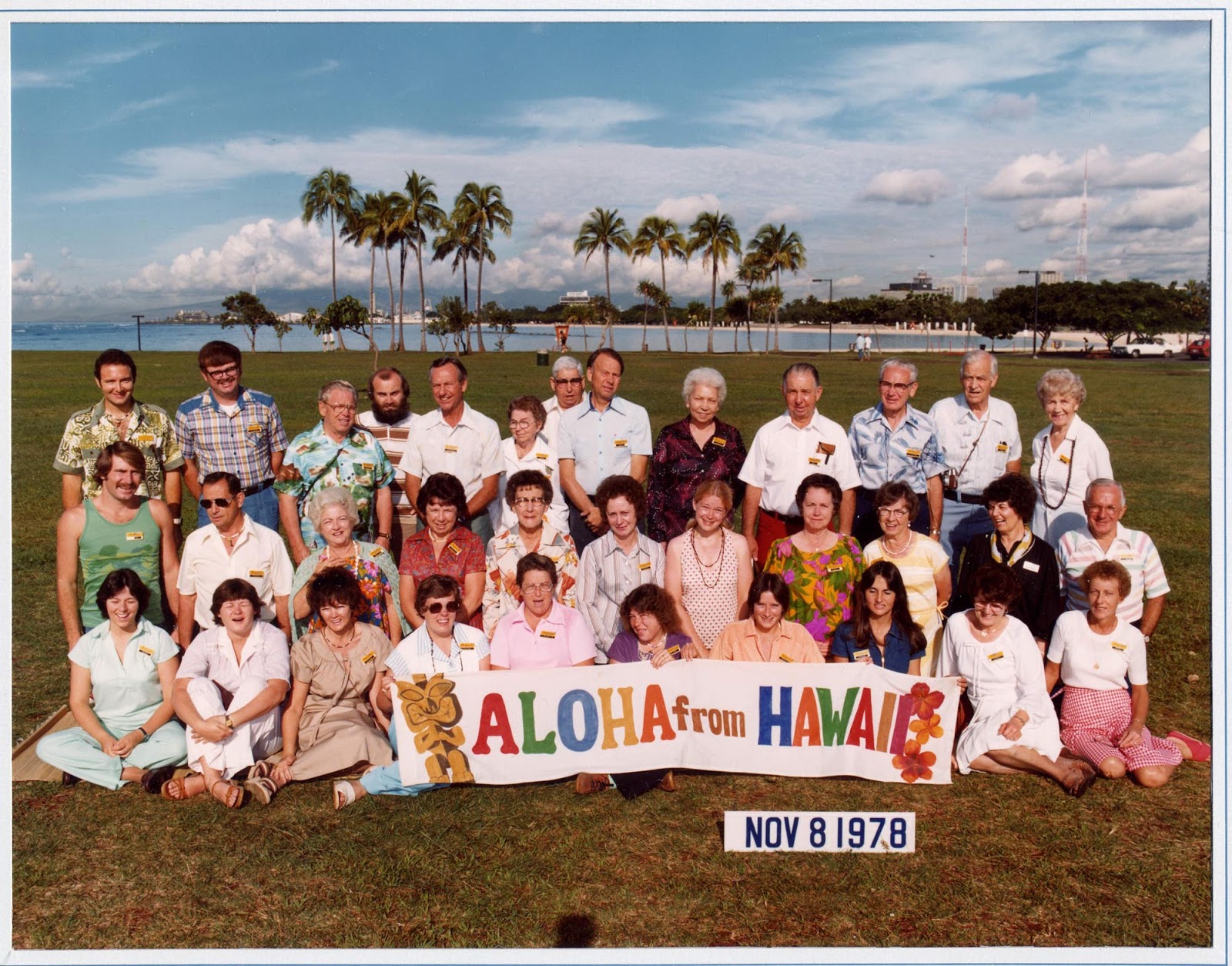
We had a vacation to Hawaii in Nov. 1978. I have also been working on the basements of both Marjorie’s and Merrill’s homes. They have been trying to finish them up. They are reaching the final stages of doing so. That brings me to this present period of time. What the future holds, no one knows. I have enjoyed my past life and don’t envy the youth. My parents are also still living at this time. Dad just turned eighty-five on April 13, 1979, and Mother will also on December 28, 1979, turn eighty-five. Zada and I have been married forty-one years and I look forward to many more. I still enjoy fishing and hunting and hope to do lots more of it. We have a 19-foot trailer and can live comfortably in it when away from home.
This autobiography was written in 1979.
Rex lived over thirty years more, and passed away April 29, 2010.
On April 29 (Wendy's birthday) Grandpa Norman passed away. He was 94 years old. He and Grandma had celebrated their 72nd wedding anniversary a couple of weeks before. Grandpa Rex was taken to the hospital at 3:00 in the morning. He was in a coma. Many family members were able to go to the hospital that day to see him and say their good-byes. Grandpa slipped away peacefully around 11:35 that night.
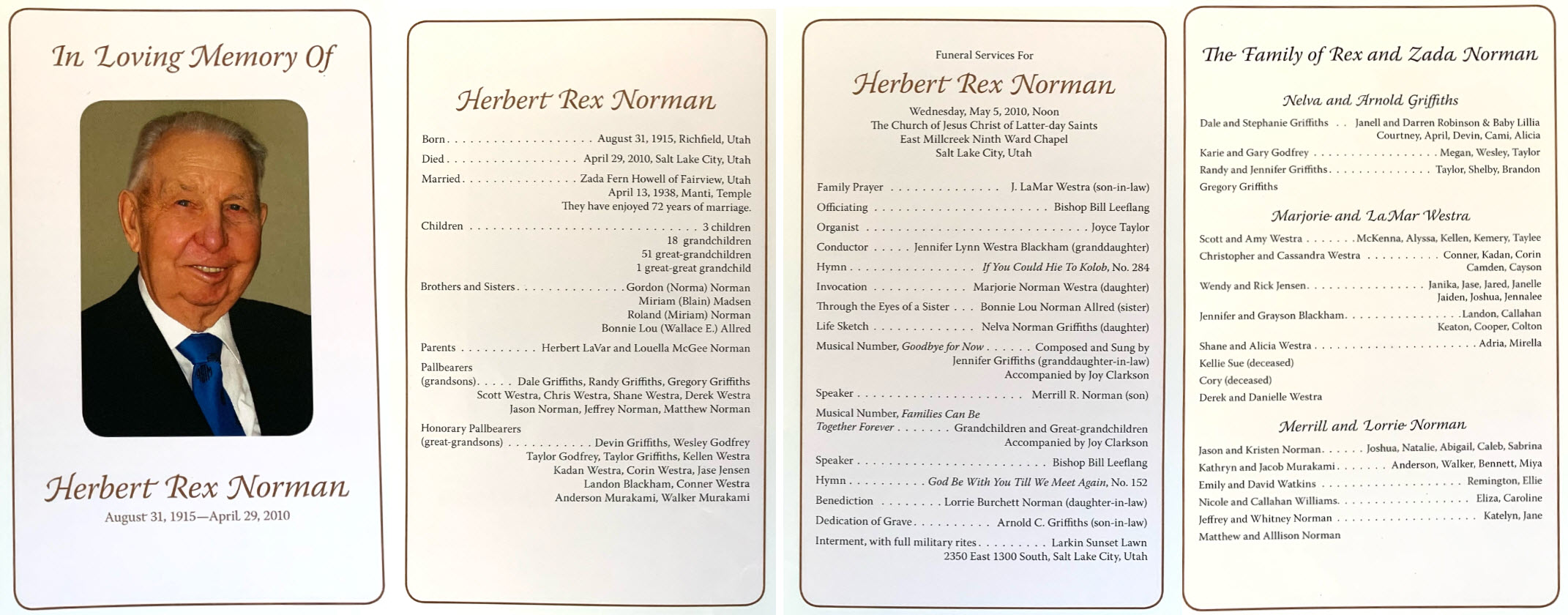
The funeral was May 5th (Derek's Birthday). Both Wendy and Jen recounted their memories on their family blogs. The Jensen Journal - Grandpa Norman Funeral and Memories. The Blackham Bunch - Goodbye Grandpa Norman. Both contain memories of Grandpa, and some reactions from the grandkids that might not have been known to everyone else.
(click on image to enlarge)
The Obituary ...
August 31, 1915 ~ April 29, 2010
On April 29, 2010, our beloved father and grandfather, Rex Norman, passed away peacefully after almost 95 years of a rich life. He leaves behind for a short season Zada, his eternal sweetheart and companion of 72 years. In their quiet and unassuming manner, they raised three children and left a legacy of five generations of 73 strong and contributing individuals, who love and revere them. As dad goes to prepare a mansion to receive her we will continue to care for our mom.
Dad was born in Richfield, Utah to Herbert LaVar and Louella McGee Norman. The family moved to Mt. Pleasant, UT where he eventually met and married Zada Howell of Fairview in the LDS Manti Temple on April 13, 1938. As a father of three, he proudly served in the Army Air Corp during WWII. They settled in Salt Lake City, where dad commenced a career in data processing, working some 33 years with the Utah State Department of Employment Security.
Dad’s favorite hobbies were hunting and fishing with family and friends, often near his ancestral home in Sanpete County or Strawberry Reservoir. He faithfully served in many capacities within his LDS ward, typically in the background, while proudly supporting his family and friends.
Rex is survived by his wife; Zada, daughters Nelva (Arnold) Griffiths, and Marjorie (LaMar) Westra and a son Merrill (Lorrie); sister Bonnie (Wallace) Allred; 16 grandchildren; 51 great-grandchildren and a great, great-granddaughter.
Preceded in death by his parents, 2 brothers, a sister and two grandchildren.
Funeral services will be held at noon, Wed. May 5th at East Millcreek 9th Ward Chapel, 3750 So. Hillside Lane (2500 E.), where family and friends may call Tues, evening 6-8 p.m. and 10:30 to 11:30 a.m. prior to services on Wed. Interment at Larkin Sunset Lawn.
As part of the service, there was a vase filled with beautiful red roses.
73 roses -- one for each of Grandma and Grandpa's descendants.
We were all instructed to take one for each family member.
At the luncheon afterward, there was a lot of visiting and remembering with relatives and cousins we hadn't seen in a while. Goodbye Grandpa ... you will be missed.
As we were organizing and labeling pictures we came across the photo in the upper left. The Manti Temple. Mom thought it was Rex and Zada's wedding day but wasn't sure. We asked around and cousin Nikki wrote "This was in an album I scanned years ago with their wedding picture. I’m almost positive it’s Rex and Zada’s wedding day. I love it because those stairs are no longer there. I remember Grandma telling me it was a very low-key and small event. She said Rex’s dad drove them to the Temple and there were very few in attendance. I believe they had a little celebration with a few friends after, but not a big wedding like we have today." The other pictures may also not be of the wedding day, but with the professional shots (likely shortly before) and with Rex's dad (their wedding day was his birthday) and how dressed up they are, it's a good guess that it is.
Mom noted that early on, Grandma Zada had actually been Zadia on some documentation.
I had never seen that, or never noticed, but sure enough ... if you look closely at the certificate above!
"In 1937, I got a job as a bookkeeper and parts manager for a Chevrolet garage that opened in town. After a few months, I purchased my first car. It was a new 1937 2-door sedan and was I proud. Up until that time it had been necessary to wash the truck, after getting it unloaded, in order to go out on a date. During this time, I met a girl I was interested in by the name of Zada Howell. I started dating her and finally asked her to dance. She took me and said the answer was yes. Needless to say, we arrived at the dance just as it was letting out. We decided to get married on April 13, 1938, in the Manti Temple."
Grandma Zada recounted ...
"Rex always kids me about proposing to him since I said "yes" on Girl's Day. In a month or two I had a pretty diamond ring on my third finger. We hoped to be married on my birthday but the Temple was closed for Conference, so we waited a week and got married in the Manti Temple on Dad Norman's birthday. This was April 13, 1938. Daddy Howell was having cancer problems by this time and Mother had spent a lot of time in Salt Lake with him... Dad couldn't go to the Temple with us but Mother went and we had a beautiful sealing. Due to Dad's illness a big wedding was out of the question; however, Miriam and Leota gave me a shower and Eva Cox had a wedding party for us."
Rick and I "interviewed" Grandma and Grandpa Norman in December of 1997. We had so much fun doing this and learned so much about them! Scroll down to click on the youtube links!
Note: I think there are some duplicates and overlap between some of these. Rick added music to some of them, which is a nice touch, but it is a little too loud in a couple of them and makes it difficult to hear the dialogue. I don't know if that can be fixed or not. It would be nice to add captions (and/or a transcript) some time. There are some lines and squares through some of them because they were on our hard-drive that crashed several years ago. We ended up having to send the hard-drive to a specialty place and they were able to recover most of the data from the hard-drive -- for a hefty price! We are grateful it was successful though!
In 1943, Nelva was four, Margie wasn't yet nine months old and Zada found she was pregnant again. This could be a challenge under any circumstances, but World War 2 was going on and there was worry that Rex would be drafted. And he was.
From Rex's written history ...
Within a very short time Uncle Sam said, “I want you.” So into the Army I went. I could have my choice of the Navy (active duty in one week) or the Marines (duty in two weeks) or the Army (duty in three weeks). Because I would have to move Zada and the girls to Mt. Pleasant and get them settled down, I had to go with the Army. I reported to Fort Douglas induction center on Feb. 2, 1944. It would usually take about five days to clear the induction center, but I spent 36 days there. I then asked how much longer I would need to remain there and they informed me that I was waiting for special orders. People with my experience on IBM equipment were in demand. When I shipped out, I couldn’t even inform my family as to where I was going.
I was told to climb on top of a truckload of barracks bags and was driven to the railroad station. All alone, I was placed aboard a troop train passing through Salt Lake City. On arriving in Denver, Colorado, I was taken to the First Air Force Base called Buckley Field. There I was to receive my basic training. I was just finishing my training and baby was about due, so I applied to the Red Cross for an emergency furlough to be home when it came. But they didn’t make any attempt to secure one. As a result, I have no use for them, as do a great many of the other GIs. When I received my shipping orders, my assignment was to a Data Processing Unit as a keypunch operator at the First Air Force Headquarters located at Mitchell Field, New York. They gave me a 15-day delay in route. I was then able to go home and be there when the baby came. Two days before I was to return to duty, our baby boy finally made his appearance. We named him Merrill Rex and he was born May 3, 1944. I then had to leave with Zada still in the hospital and to go to Mitchell Field, NY, still traveling alone. For the next 20 months, I was assigned there.
I received the rank of Corporal and was eligible for Sergeant, but they froze the rankings. I was also on shipping orders twice for overseas, but they stopped because of my M.O.S classification, which was 300. I was also on orders to transfer to the Infantry for the Battle of the Bulge. I was also given a chance to go to Arial Gunnery School for the bombers, which I turned down. While there, I went from the keypunch to the tabulating equipment. There I was in charge of consolidating all the reports from over 30 airbases in the First Air Force and sending a daily report to the Continental Air Force Headquarters in Washington D.C.
The war was not yet over. I was looking forward to getting home, but they were holding me in because of the two-year clause. I had 65 points toward discharge and the Air Force was down to 35 points for the release. Finally in Dec. 1945, changes were made and I was eligible for release. I would watch every list that they posted, which was about every two hours. Finally on Dec. 14, 1945, on the last list for the day, my name appeared. I could go to Fort Douglas, Utah for release or get it at Mitchell Field and get travel expenses home. I wanted to be sure and get home as fast as possible and sure I would be home for Christmas. So I took my discharge there. I told the C.O. goodbye and ran to the barracks; there I threw everything into my barracks bags and went to the separation center. It was only two barracks away and I started to process at once. By noon the next day, with my discharge in my hand, I was on my way to New York and home. What a happy day. I arrived home just before Christmas.
In Grandma Zada's history, she also mentions how they were worried about the draft. That Merrill was 10 days late and they were afraid Grandpa Rex would have to go back before the birth. She lived in Mt. Pleasant, renting a couple of different houses while he was gone. She said "Rex sent us gifts and was able to get home a couple of times. I will never forget the day President Roosevelt died, or the rationing that went on during the war. I kept so busy I didn't have time to get too lonely. Soon the war was over and Rex would be home. What a happy day that was!"